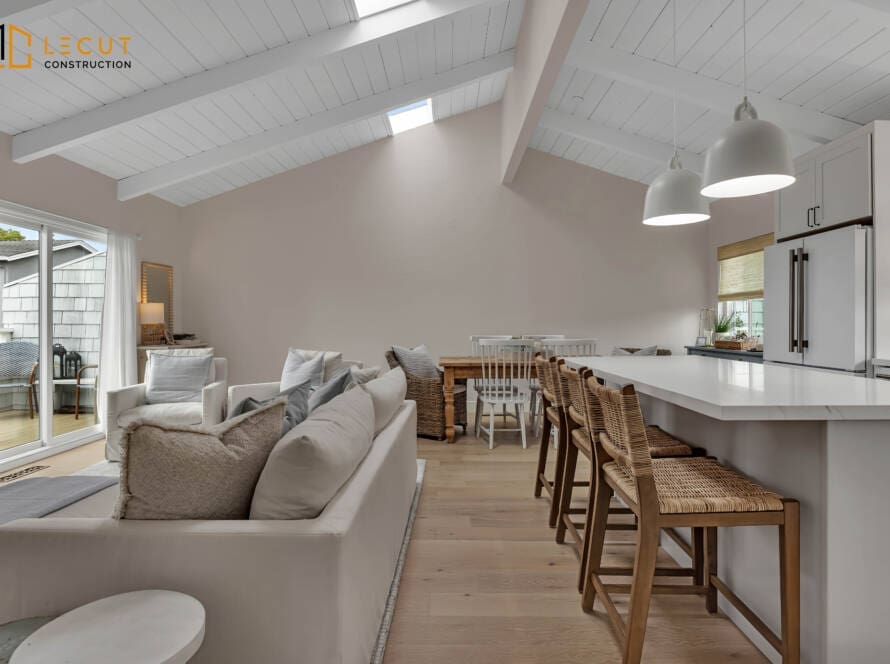

Transforming a compartmentalized floor plan into an open-concept living space is one of the most impactful upgrades you can make to a San Jose home. Removing an interior wall lets natural light flow between the kitchen, dining, and living areas while dramatically improving everyday usability. However, when that wall is structural, removing it requires precise engineering, specialized material handling, and rigorous adherence to local building codes.
In our extensive residential contracting experience across Santa Clara County, we have found that homeowners often underestimate what happens above and below a load-bearing wall. A load-bearing wall does far more than separate rooms; it forms a critical vertical link in your home’s structural framing. Removing it without engineered replacement support risks structural sagging, cracked finishes, jamming doors, and severe seismic vulnerability.
Table of Contents
Structural Requirements and Load Path Mechanics in Seismic Zones
Every house is designed around a continuous load path—a system of structural members that transfers gravity and lateral loads down into the earth. When we evaluate an interior wall in a San Jose residence, we analyze two distinct force mechanisms:
Gravity Loads
- Vertical loads consist of dead loads (the permanent weight of roof trusses, ceiling joists, drywall, and roofing materials) and live loads (furniture, occupants, and moveable equipment).
- A load-bearing wall transfers these downward forces from upper stories or ceiling joists to floor joists, girders, and foundation walls.
- Replacing a bearing wall requires an engineered beam (header) capable of spanning the clear opening while maintaining allowable deflection limits (typically L/360 for plaster or drywall ceilings under total load).
Lateral Seismic Loads
- San Jose sits within a high-risk seismic zone influenced by the San Andreas and Hayward Fault lines. Under the California Building Standards Commission guidelines, structural alterations must maintain the building’s lateral force-resisting system.
- Interior load-bearing walls frequently double as shear walls or braced wall panels, preventing the house from racking or twisting during an earthquake.
- When we remove a structural wall, we must often install dedicated shear panels, steel post hold-downs (such as Simpson Strong-Tie HDUs), or continuous momentum frames to preserve lateral stability.
Structural Variations Across San Jose Neighborhoods
San Jose features diverse architectural styles constructed across different eras. Structural characteristics vary significantly depending on the home’s vintage and neighborhood:
Historic Victorians and Craftsman Bungalows
- Common in Naglee Park, Downtown San Jose, and Japan Town.
- Constructed with true dimensional lumber, lath-and-plaster wall systems, and high ceiling cavities.
- Walls often bear continuous multi-story loads or heavy ceiling joist structures. Plaster removal creates high dust volume and requires careful containment.
Mid-Century Eichler and Ranch Homes
- Common in Rose Garden, Willow Glen, and Cambrian Park.
- Post-and-beam construction and low-pitch roofs with heavy tongue-and-groove roof decking.
- Eichler homes feature minimal interior studs; load paths rely on precise post locations. Ranch homes often utilize simple continuous center bearing walls running perpendicular to ceiling joists.
Modern Suburban Infill & Two-Story Homes
- Common in Almaden Valley, Berryessa, and Silver Creek.
- Built using pre-engineered gang-nail roof trusses or engineered I-joists (TJI).
- Trusses are designed to span wide distances, but interior webs or intermediate chords may still rely on interior partition walls for deflection control or floor-to-floor load transfer.
Real-World Resolution: Handling Unforeseen Structural and Mechanical Collisions
During an open-concept remodel in a mid-century home near the Rose Garden, our team encountered a complex structural challenge. The homeowner wanted to open a 22-foot span between the kitchen and family room. Upon opening the drywall, we discovered that the existing bearing wall not only supported the roof trusses but also housed the main electrical subpanel feeder and a vertical HVAC supply trunk. Additionally, the wall served as a primary lateral shear panel for the home’s mid-section.
To resolve this issue without compromising the open layout:
- We collaborated with a licensed CA structural engineer to specify a 14-inch deep Flush Steel W-Beam (W8x31) nestled into the attic ceiling framing.
- We installed custom steel hanger brackets to hold ceiling joists directly to the steel beam, eliminating any ceiling drop.
- To replace the lost lateral shear strength, we engineered two end posts anchored with heavy-duty hold-downs to new 24-inch by 24-inch by 18-inch deep reinforced concrete pad footings poured beneath the crawlspace floor.
- Our licensed sub-trades re-routed the electrical feeder through an adjacent exterior wall and split the single duct into two high-efficiency floor runs, passing all City of San Jose field inspections on the first submittal.
Step-by-Step Structural Demolition and Installation Process
Removing a load-bearing wall follows a mandatory sequence to maintain safety and structural integrity throughout construction:
- Engineering and Architectural Mapping: A licensed engineer conducts a site investigation, measures spans, calculates tributary roof/floor areas, and produces stamped structural plans.
- City Permitting: Submittal of structural drawings and calculations to the city building department for plan check approval.
- Dust Containment and Site Prep: Installation of floor protection and negative-pressure plastic containment barriers to protect the rest of the living space.
- Temporary Shoring Assembly: Building adjustable shoring walls (using acrow props/screw jacks and top/bottom plates) on both sides of the target wall to temporarily carry upper framing loads down to solid subflooring or crawlspace piers.
- Wall Demolition and Mechanical Discovery: Stripping drywall, removing framing studs, and safely disconnecting or relocating embedded electrical wiring, plumbing stacks, or gas lines.
- Foundation Upgrades: Excavating beneath the floor, cutting concrete slabs if necessary, and pouring dedicated concrete point-load footings to support the end posts of the new beam.
- Beam Elevation and Post Anchorage: Lifting the engineered wood or steel beam into position, securing end columns, and attaching structural hardware (squash blocks, column caps, and hold-down anchors).
- Structural Framing Inspection: City inspector verifies beam sizing, post connections, temporary shoring, and load paths before any walls are closed up.
- Finishing Work: Installing fire-rated drywall, taping, mudding, matching existing ceiling textures, and weaving floor patches.
Permitting, City Codes, and Environmental Regulations
In Santa Clara County, structural modifications require explicit municipal oversight. Performing unpermitted structural alterations introduces severe legal, financial, and safety liabilities.
City of San Jose Building Division Requirements
- A formal building permit is legally mandatory for any alteration involving structural load paths, header beam installation, or wall removals.
- Plans must be submitted through the official portal or via plan review services provided by the City of San José Building Division.
- While non-structural cosmetic updates can bypass plan checks, structural wall removals require stamped calculations from a California-licensed professional engineer (PE) or structural engineer (SE).
Bay Area Air Quality Management District (BAAQMD) and Lead Compliance
- Homes built prior to 1978 frequently contain lead-based paint and asbestos within drywall mud, acoustic ceiling spray (popcorn ceiling), or lath plaster.
- Prior to structural demolition, demolition projects require compliance filings with the Bay Area Air Quality Management District to confirm asbestos testing and safe disposal protocols.
Risks of Unpermitted Work
- Title and Escrow Friction: Real estate disclosures require reporting unpermitted structural changes. Buyers’ lenders will refuse financing unless unpermitted work is retroactively permitted or corrected.
- Insurance Denial: If an unpermitted beam fails during a seismic event or normal operation, property insurance providers may deny coverage for resulting damages.
Beam Selection Criteria and Engineering Specs
Choosing the correct beam depends on span length, load weight, ceiling depth constraints, and budget considerations. Below is a comparative overview of standard structural beams used in San Jose remodels:
| Beam Material | Span Capability | Profile Depth | Relative Material Cost | Primary Application |
|---|---|---|---|---|
| Laminated Veneer Lumber (LVL) | Short to Medium (Up to 18 ft) | Moderate (9.25 to 14 inches) | Lower (Cost-Effective) | Single-story wood roof framing, standard drop-beam applications. |
| Parallel Strand Lumber (PSL) | Medium to Long (Up to 24 ft) | Moderate to High (11.875 to 18 inches) | Moderate | Heavy load points, open multi-story spans, heavy tile roofs. |
| Glue-Laminated Timber (Glulam) | Medium to Long (Up to 28 ft) | Moderate to Deep | Moderate | Architectural exposed beams, high-load ridge beams, long clear spans. |
| Structural Steel (W-Beam / I-Beam) | Long Spans (20 ft to 30+ ft) | Compact / Shallow (8 to 12 inches) | Higher (Requires crane / heavy rigging) | Flush-ceiling installations where attic ceiling depth is restricted. |
Comprehensive Cost Breakdown for San Jose Projects
Costs for load-bearing wall removal in San Jose vary based on beam material, plumbing/electrical complexity, and foundation needs. Below is an itemized breakdown expressed in US dollars:
| Project Phase / Component | Estimated Cost Range (in US Dollars) | Structural Role & Cost Factors |
|---|---|---|
| Structural Engineering & Calculations | 800 USD to 1,500 USD | Site assessment, load calculations, and stamped structural drawings. |
| City Building Permit & Review Fees | 500 USD to 1,200 USD | City of San Jose plan review, permit issuance, and field inspection fees. |
| Environmental Testing (Asbestos/Lead) | 300 USD to 600 USD | Pre-demolition testing for homes constructed prior to 1978 (BAAQMD compliance). |
| Temporary Shoring & Site Protection | 400 USD to 900 USD | Adjustable screw jacks, timber shoring walls, and dust containment zones. |
| Structural Beam Material (LVL, PSL, Steel) | 500 USD to 2,200 USD | Raw material costs based on length, load weight, and material choice. |
| Foundation Footing Upgrades | 900 USD to 2,500 USD | Slab cutting, soil excavation, rebar placement, and concrete pad pouring. |
| Framing, Lifting, and Hardware | 1,800 USD to 4,500 USD | Skilled carpentry labor, beam hoisting, end post installation, and hold-down hardware. |
| Utility Relocation (Trades) | 600 USD to 2,500 USD | License-holder labor to reroute electrical wiring, plumbing pipes, or HVAC vents. |
| Drywall Patching, Texturing, and Paint | 1,200 USD to 2,800 USD | Sheetrock installation, Level 4/5 mudding, texture matching, and painting. |
| Flooring Weave & Patching | 400 USD to 1,200 USD | Infilling wood planks, tile, or subfloor transition strips beneath the old footprint. |
Total Project Investment Range: 7,400 USD to 19,900 USD for a fully permitted, professionally engineered structural wall removal in San Jose.
Alternatives to Full Load-Bearing Wall Removal
If budget or utility placement prevents removing a wall entirely, several structural alternatives provide an open feel while preserving lateral and gravity paths:
Partial Wall Cased Opening
- We retain short stub-walls (return walls) at the perimeter ends.
- Reduces beam span length, allowing smaller engineered wood beams rather than costly steel I-beams.
Exposed Structural Column Support
- Placing a vertical post midway across a long opening breaks a continuous 24-foot span into two 12-foot spans.
- Reduces beam depth requirements, allowing a standard drop beam to fit neatly within the existing ceiling height.
Structural Knee-Wall or Pass-Through
- Removing only the top half of the wall creates an integrated breakfast bar or kitchen pass-through counter.
- Keeps lower plumbing lines or electrical outlets intact, avoiding expensive concrete trenching or subfloor re-routing.
Frequently Asked Questions
How can we definitively tell if an interior wall in our San Jose home is load-bearing?
You cannot determine whether a wall is load-bearing simply by knocking on drywall, measuring wall thickness, or checking its location relative to hallways. Definitively identifying structural function requires inspecting the roof and ceiling framing from the attic or crawlspace. We verify whether ceiling joists, roof rafters, floor joists, or truss webs bear directly onto the top plate of the wall. If upper structural framing terminates on or crosses perpendicular over the wall, it is load-bearing. A structural engineer or licensed contractor should perform this assessment before any demolition begins.
Is a building permit strictly required by the City of San Jose for removing an interior wall?
Yes, a building permit is legally required for removing any structural or load-bearing wall within San Jose city limits. Non-bearing partition walls can sometimes be modified without structural plan checks, but altering framing that supports floor, ceiling, or roof loads requires engineering calculations, stamped plans, and city inspections. Skipping the permit process creates major legal issues during home resale, can invalidate homeowners insurance coverage, and risks safety violations.
What is the difference between a flush beam and a drop beam installation?
A drop beam sits directly underneath the existing ceiling joists. The bottom of the beam hangs down into the room, creating a visual soffit or archway between spaces. A flush beam is hoisted up into the ceiling cavity. The surrounding ceiling joists are cut back and secured to the sides of the beam using metal joist hangers. Flush beams create a seamless, continuous flat ceiling between rooms, but they require extra labor, attic clearance, and careful mechanical rerouting.
How long does a load-bearing wall removal project take from planning to final inspection?
A standard project takes between 3 and 7 weeks from start to finish. Planning, structural engineering calculations, and City of San Jose permit approval typically require 2 to 4 weeks depending on building department plan review turnaround times. Physical construction—including site protection, temporary shoring erection, demolition, framing, beam placement, city inspections, drywall finishing, and flooring patches—generally takes 1 to 2 weeks on site.
What happens if we discover hidden electrical wires or plumbing pipes inside the load-bearing wall?
It is common to discover electrical home-runs, plumbing vent stacks, or heating ducts hidden inside an interior wall once the drywall is removed. These utilities cannot simply be cut or capped off. Licensed electricians and plumbers must reroute the lines up through the ceiling joists, down through the subfloor crawlspace, or into adjacent perimeter walls. This trade work must be completed and inspected during the rough framing phase before installing drywall or closing up ceilings.
Sources
- City of San José Planning, Building and Code Enforcement Development Services: https://www.sanjoseca.gov/your-government/departments-offices/planning-building-code-enforcement/building-division
- California Building Standards Commission (Title 24 Structural Codes): https://www.dgs.ca.gov/BSC
- Bay Area Air Quality Management District (Asbestos Demolition Rules): https://www.baaqmd.gov