Table of Contents
Standard Clearance and Spatial Mechanics for San Jose Kitchens
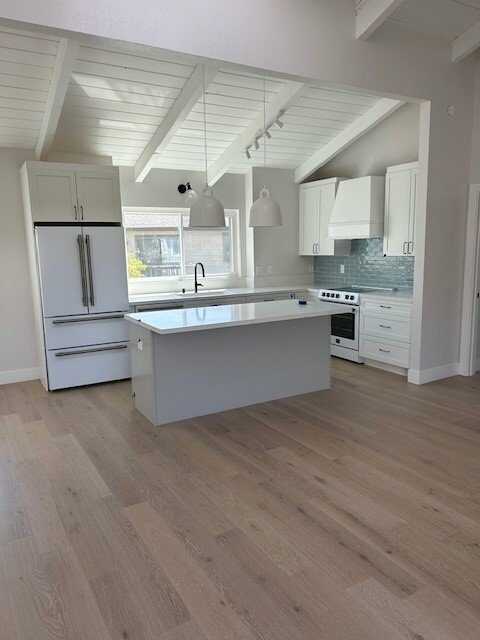
Designing a functional kitchen island begins with understanding spatial ergonomics and traffic flow. In our years of executed kitchen remodels across Santa Clara County, we frequently encounter islands that look impressive on paper but create immediate functional bottlenecks during everyday use. An island must preserve the primary work triangle—connecting the primary prep sink, cooktop, and refrigeration center—without obstructing natural walkways.
Proper spatial clearances must be calculated using finished wall and cabinet dimensions, incorporating counter overhangs, appliance handles, and door swings.
Key Spatial Guidelines for Kitchen Island Layouts
- Work Aisle Clearances: The National Kitchen & Bath Association (NKBA) recommends a minimum work aisle width of 42 inches for single-cook environments and 48 inches for multi-cook configurations.
- Major Walkway Clearances: Secondary passage zones outside the immediate cooking zone require a minimum clear width of 36 inches, though 42 to 48 inches is preferred when adjacent to high-traffic pathways.
- Appliance Clearance Zones: Dishwasher doors require approximately 24 inches of clear space to drop fully open, while oven doors require 30 inches. Combining an open dishwasher door with an open oven door across an aisle requires at least 48 inches of total clearance to allow emergency passage.
- Seating Clearances: Counter-height seating (36-inch counter level) requires a minimum knee clearance depth of 15 inches and a linear width allocation of 24 inches per seated individual. Bar-height seating (42-inch counter level) requires 12 inches of knee clearance.
+-----------------------------------------------------------------------+
|                         PRIMARY WORK AISLE                            |
|             Minimum 42 inches (Single Cook) / 48 inches (Two Cooks)   |
|                                                                       |
|   +-----------------------+              +------------------------+   |
|   |   Perimeter Counter   |              |     Kitchen Island     |   |
|   |   & Main Appliances   |              |     Prep / Worktop     |   |
|   +-----------------------+              +------------------------+   |
|                                                                       |
|                          PASSAGEWAY / SEATING                         |
|             Minimum 36 inches (Walkway) / 44+ inches (Seating)       |
+-----------------------------------------------------------------------+
Navigating Structural and Historical Constraints in Bay Area Neighborhoods
Older residential zones across San Jose present structural challenges that directly impact island placement and utility integration. Properties built prior to 1980 in neighborhoods like Naglee Park, Rose Garden, and Willow Glen often feature floor plans with original load-bearing walls, subfloor plumbing stacks, or concrete slab-on-grade foundations.
When we approach kitchen reconfigurations in these homes, standard island dimensions must adapt to existing structural limits. Below are two complex real-world structural challenges we resolved in San Jose residences:
Case Study 1: Naglee Park Tudor Load-Bearing and Plumbing Reroute
In a 1920s Tudor home in Naglee Park, the homeowner wanted a central 8-foot island with an integrated wet bar sink. The original kitchen was partitioned by a interior load-bearing partition wall housing a main vertical plumbing stack serving an upper-floor bathroom.
To resolve these constraints:
- We structural engineer-certified the removal of the load-bearing wall, replacing it with a recessed 10-inch steel flush beam hidden entirely within the ceiling joist space.
- The vertical plumbing stack was offset laterally into an exterior wall cavity using double 45-degree fitting sweeps to satisfy drainage slope codes.
- We installed a 7-foot prep island with 44 inches of perimeter clearance, preserving floor joist integrity while integrating a prep sink without trenching through historic perimeter footings.
Case Study 2: Willow Glen Mid-Century Slab Core-Drilling and Electrical Retrofit
A mid-century home in Willow Glen featured a post-and-beam design built on a concrete slab-on-grade foundation. The owner requested a massive waterfall-edge island equipped with cooktop burners and multiple electrical outlets, but the home possessed an original 100-amp main electrical panel and no existing subfloor wiring access.
To resolve these constraints:
- We coordinated an electrical panel upgrade with the local utility to install a modern 200-amp service panel.
- We precision core-drilled low-profile floor raceways into the concrete slab to deliver two dedicated 20-amp small-appliance branch circuits to the island base.
- We integrated dual pop-up tamper-resistant Ground Fault Circuit Interrupter (GFCI) power modules directly flush into the quartz top to maintain California Electrical Code compliance without compromising the quartz waterfall edges.
Functional Island Archetypes and Layout Strategies
An island must be tailored to specific utility demands rather than attempting to serve every household function simultaneously. Compromising between too many features creates cluttered work surfaces and dangerous traffic intersections.
Prep-Only Islands
Prep islands focus entirely on uninterrupted raw counter surface. They are ideal for compact to mid-sized kitchens where plumbing or gas extensions would be cost-prohibitive.
- Minimal dimensions of 4 feet by 2 feet fit comfortably in compact floor plans while providing dedicated workspace.
- Eliminating sinks and cooktops eliminates complex subfloor trenching and mechanical venting overhead.
- Placing a prep island directly between the primary refrigeration unit and main cooking zone minimizes footsteps during food preparation.
Cooking Islands
Integrating a cooktop into an island converts the surface into a primary cooking station. However, this layout introduces safety considerations and strict ventilation compliance under the California Mechanical Code.
- Minimum required island footprint is 5 feet by 3 feet to ensure adequate landing space on both sides of the burner.
- At least 12 inches of continuous landing counter is required on one side of the cooktop, with 15 inches on the opposing side.
- For islands at a single flush height, NKBA standards specify a safety buffer of at least 9 inches behind the burners to protect individuals standing or sitting behind the cooking surface.
- High-CFM overhead ventilation hoods or high-efficiency downdraft systems must be incorporated to handle combustion products and grease vapor.
Seating and Multi-Tier Islands
Multi-tier islands split the surface between a 36-inch cooking or prep level and a elevated 42-inch eating bar. This physical separation shields seated guests from cooking splatters and hides sink prep clutter.
- Elevated 42-inch tiers allow reduced knee depth clearance of 12 inches compared to the 15 inches required for standard 36-inch counter-height seating.
- Single-level continuous seating islands create a larger visual surface area but demand larger overall floor space to prevent seating areas from encroaching into cooking safety zones.
Regulatory and Electrical Compliance in Santa Clara County
Kitchen remodeling projects in San Jose are regulated by the California Building Standards Commission (Title 24) and local modifications enforced through the City of San José Building Safety Division. Adherence to these codes is legally required for project sign-off and home resale disclosures.
Electrical Receptacle Mandates (CEC 210.52(C))
Under current California Electrical Code standards applicable in San Jose, kitchen islands and peninsulas require specific receptacle installations based on overall countertop area:
- Outlets are required for any island countertop space with a long dimension of 24 inches or greater and a short dimension of 12 inches or greater.
- Outlets mounted below the countertop surface cannot be positioned more than 12 inches below the counter face, nor can they be installed where the countertop extends more than 6 inches horizontally beyond its support base.
- Countertop surface-mounted outlets must be listed, code-approved pop-up receptacle assemblies; standard face-up outlet receptacles installed flat in countertops are strictly prohibited.
- All 120-volt, 15-amp and 20-amp kitchen branch circuits supplying island outlets require Arc-Fault Circuit Interrupter (AFCI) and Ground Fault Circuit Interrupter (GFCI) protection.
Title 24 Lighting and Energy Efficiency Standards
- Island task lighting must utilize high-efficacy LED fixtures controlled by independent dimmer switches or automated lighting control systems.
- Heavy appliance loads embedded in islands—such as warming drawers, microwave drawers, or wine refrigerators—must be served by dedicated individual branch circuits.
Comprehensive Island Layout Comparison Guide
The following table details key spatial, utility, and financial parameters for selecting island layouts based on available kitchen square footage in San Jose homes.
| Island Layout Archetype | Ideal Room Square Footage | Minimum Island Footprint | Minimum Perimeter Clearance Required | Required Electrical & Plumbing Utilities | Estimated Remodel Investment Range |
|---|---|---|---|---|---|
| Compact Prep Island | Under 120 sq ft | 4 ft x 2 ft | 36 in walkway / 42 in work aisle | 1 dedicated GFCI 20A circuit | 4,000 to 8,000 US Dollars |
| Full Prep & Storage | 120 to 200 sq ft | 6 ft x 3 ft | 42 in work aisle | 2 GFCI 20A circuits, pop-up outlets | 9,000 to 16,000 US Dollars |
| Cooking Station Island | 180 to 280 sq ft | 6 ft x 3 ft 6 in | 48 in multi-cook work aisle | 200A service upgrade, 240V/Gas line, dedicated vent ducting | 18,000 to 32,000 US Dollars |
| Integrated Sink & Seating | 200 to 320 sq ft | 8 ft x 4 ft | 42 in work aisle / 48 in behind seating | DW circuit, disposal, hot/cold plumbing line, drain vent, 2 GFCI circuits | 22,000 to 40,000 US Dollars |
| Multi-Tier Executive Island | Over 300 sq ft | 9 ft x 4 ft 6 in | 48 in work aisle / 48 in passage aisle | Full panel service, multi-circuit subpanel integration, gas/electric, plumbing | 35,000 to 60,000 US Dollars |
Common Layout Pitfalls and Remediation Strategies
Through our field experience correcting failed DIY and non-specialist island designs, we have identified recurring structural and layout errors:
Sinks Placed at Island Margins
Placing a prep sink closer than 18 inches to the outer edge of an island causes frequent water splashing onto finished floor surfaces. Over time, water infiltration causes warping in engineered hardwood or subfloor rot. Sinks should always maintain a minimum 18-inch continuous counter buffer on both sides.
Retrofitted Waste and Recycling Bins
Failing to integrate dedicated pull-out trash and recycling cabinets into the initial millwork framing forces homeowners to use freestanding cans that block primary walkways. Waste pull-outs should be placed directly adjacent to the main prep sink or prep zone.
Electrical Service Bottlenecks
Attempting to install high-draw kitchen appliances—such as induction cooktops or speed ovens—on existing original 100-amp electrical panels in older San Jose homes leads to frequent breaker trips. Homeowners should budget for a main panel upgrade to 200 amps before installing built-in electrical island appliances.
+-------------------------------------------------------------------------+
|                  CORRECT ISLAND CLEARANCE & PLACEMENT                   |
|                                                                         |
|        [ Refrigerator ]                   [ Primary Range ]             |
|               |                                  |                      |
|               |<------ 42 to 48 Inches Aisle ---->|                      |
|               v                                  v                      |
|       +--------------------------------------------------+              |
|       | [ 18 in Buffer ]  ( Prep Sink )  [ 18 in Buffer ]|              |
|       |                                                  |              |
|       |             Integrated Island Surface            |              |
|       |                                                  |              |
|       |  [ Pull-out Waste ]          [ Seating Overhang ]|              |
|       +--------------------------------------------------+              |
|               ^                                  ^                      |
|               |<------ 36 to 48 Inches Walkway -->|                      |
+-------------------------------------------------------------------------+
Frequently Asked Questions
What is the minimum kitchen clearance required for a functional kitchen island in San Jose?
The standard minimum clearance between a kitchen island and perimeter cabinets or appliances is 42 inches for a single-cook layout and 48 inches for a multi-cook household. Non-cooking passage walkways require a minimum clear space of 36 inches. These distances ensure appliance doors can fully extend without colliding with the island structure.
How do local Santa Clara County building codes impact kitchen island electrical outlet placement?
Under the California Electrical Code enforce in San Jose and Santa Clara County, islands with countertop surfaces measuring 24 inches by 12 inches or larger require GFCI-protected electrical outlets. Outlets must be placed no lower than 12 inches below the countertop face and cannot be installed beneath overhangs exceeding 6 inches. Pop-up receptacles mounted flush inside the countertop surface must be specifically listed for countertop installation.
Can we add a kitchen island to a small bungalow or condo kitchen without compromising space?
Yes, provided the total room width allows for proper work aisle clearances. If a room cannot maintain a minimum 36-inch clearance on all sides, a fixed island will create severe traffic bottlenecks. In compact spaces under 10 feet total width, a narrow prep cart or a butcher-block table on casters provides flexible prep space without violating permanent clearance codes.
What are the overhang and knee space requirements for kitchen island seating?
For standard counter-height islands (36 inches high), seating requires a minimum knee clearance depth of 15 inches. For bar-height islands (42 inches high), knee clearance depth can be reduced to 12 inches. Each seated individual requires at least 24 inches of linear counter width to prevent crowding.
How much does it cost to fix an improperly sized or incorrectly placed kitchen island?
Correcting an improperly positioned or sized island usually requires removing existing cabinetry, modifying electrical wiring, repairing subfloor structures, and purchasing new countertops. Remediation costs typically range between 5,000 and 15,000 US Dollars depending on whether plumbing lines, gas feeds, or structural flooring adjustments are involved.
Sources
- City of San José Building Safety Division, Electrical and Kitchen Remodel Permit Guidelines.
- California Building Standards Commission, California Electrical Code (CEC – Title 24, Part 3).
- National Kitchen & Bath Association (NKBA), Kitchen Planning Guidelines with Access Standards.
- National Fire Protection Association (NFPA), NEC Section 210.52(C) Receptacle Requirements for Islands and Peninsulas.