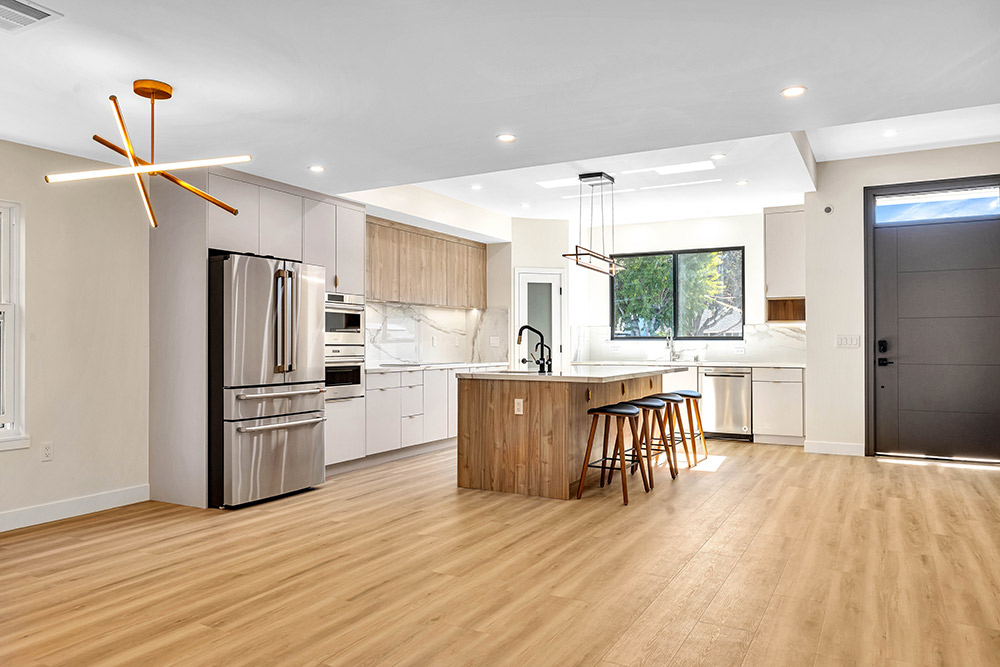
Navigating open concept living room layouts in San Jose requires balancing modern visual appeal with structural integrity, seismic safety, and energy performance. Over years of remodeling homes throughout Silicon Valley, our perspective on open living spaces has evolved significantly. When we began removing partition walls in San Jose, the standard renovation strategy was straightforward: remove every possible non-exterior wall to create one wide, continuous space spanning the kitchen, dining room, and primary living area.
While that expansive aesthetic remains visually appealing in design photographs, years of real-world occupancy have demonstrated that fully open floor plans introduce specific performance trade-offs. In San Jose, where much of the residential housing stock consists of mid-century ranch homes, Eichler builds, and early post-war split-levels, an unrefined open-space strategy often creates issues with acoustics, heating and cooling balance, loss of storage, and structural integrity.
A successful open concept layout does not mean eliminating all physical boundaries. Instead, it requires deliberate spatial zoning, precise structural engineering, compliance with California energy mandates, and architectural solutions tailored to the microclimates and housing styles of Santa Clara County.
Table of Contents
Structural Realities and Seismic Considerations in South Bay Architecture
Removing interior walls in older South Bay homes requires a clear understanding of structural framing systems. Residential neighborhoods in San Jose—such as Willow Glen, Cambrian Park, Almaden Valley, and the Rose Garden—feature distinct framing methods built primarily between 1950 and 1980.
- Mid-century ranch homes frequently utilize load-bearing central corridor walls that support ceiling joists, roof trusses, or mid-span rafter ties.
- Eichler homes and post-and-beam constructions rely on specific post locations and integrated shear panels to transfer lateral loads to the foundation.
- Multi-level and split-level homes use interior partitions to hide primary plumbing stacks, electrical risers, and main HVAC trunk lines serving the upper levels.
Because San Jose sits between active fault lines, structural wall removal falls under strict provisions of the California Building Code. Removing a load-bearing wall requires replacing its support capacity with engineered headers—typically Glue-Laminated timber (Glulam) or structural steel Wide-Flange (I-beam) members—supported by continuous post load paths that transfer weight directly to reinforced concrete footings.
Structural Engineering Guidelines for Open Concept Renovations
- Load Path Continuity: Any point load created by a structural beam post must align over a pier, pad, or thickened slab footing. If the existing foundation cannot support the concentrated load, new concrete footings must be poured in the crawlspace or subfloor.
- Seismic Shear Resistance: Interior walls in California homes often double as shear walls, providing lateral stability against earthquake forces. Removing these walls requires installing replacement shear panels or moment frames engineered to meet local seismic standards.
- Flush Beams versus Dropped Beams: A flush beam is installed inside the ceiling cavity, creating a flat ceiling plane across the open space. A dropped beam sits directly below the ceiling joists, which is less labor-intensive but creates a visible horizontal break in the ceiling plane.
Navigating San Jose Building Permits and Municipal Requirements
Executing a structural layout change in San Jose requires mandatory plan review and permit issuance. Attempting unpermitted structural alterations compromises home safety, voids homeowner insurance coverage during seismic events, and complicates future real estate transactions.
The City of San José Building Division evaluates structural plan sets to ensure framing compliance and proper lateral force design. Minor interior alterations that do not involve complex lateral load calculations may qualify for Over-the-Counter or expedited Residential Express plan review services. However, projects involving large structural beam spans, new shear walls, or foundation modifications require full Standard Plan Review, including stamped engineering calculations from a licensed California structural engineer.
Energy Code Compliance: Balancing Open Layouts with Title 24
A major challenge in creating wide open concept spaces is maintaining year-round thermal comfort while complying with California state energy standards. Under the 2025 California Building Energy Efficiency Standards (Title 24, Part 6), major residential remodels and alterations must meet strict energy performance metrics.
When interior walls are removed, airflow patterns across the residence change instantly. A single HVAC thermostat that previously controlled a small, enclosed living room must now manage a large volume of air connecting cooked-food zones, expansive glass patio doors, and high-ceiling seating areas.
- Thermal Load Distribution: Kitchen appliances, south-facing windows, and media centers generate localized heat loads. In an open space, single-zone forced-air systems struggle to maintain uniform temperatures without multi-zone dampers or high-efficiency variable-speed heat pumps.
- Fenestration and Solar Heat Gain: Open concept conversions in San Jose often include adding large multi-panel sliding or bifold glass doors to connect the living room to an outdoor patio. Under Title 24, high-performance low-E glass with low U-factor and low Solar Heat Gain Coefficient (SHGC) ratings is mandatory to prevent massive afternoon heat gain in Silicon Valley’s summer climate.
- Air Filtration and Wildfire Mitigation: Open concept homes in South Bay locations near foothills, such as Almaden or Silver Creek, require robust indoor air filtration. Integrating MERV-13 or higher filtration into the HVAC system keeps particulate matter from dispersing across the entire floor plan during dry summer and autumn wildfire seasons.
For deeper technical details on mandatory building efficiency metrics, home builders and design teams reference the official California Energy Commission Title 24 Standards.
Managing Sound and Acoustics in Wide Open Spaces
Acoustics present an ongoing challenge in open concept residential design. Removing sound-blocking drywall panels allows sound waves from television speakers, kitchen appliances, dishwashers, and conversations to bounce unimpeded across hard interior surfaces.
In San Jose homes featuring oak hardwood flooring, quartz countertops, and vaulted drywall ceilings, an open layout can create unpleasant acoustic echoes. Correcting sound transmission requires building sound dampening directly into the architectural specification rather than relying entirely on decorative soft goods.
Architectural Acoustic Solutions
- Acoustic Ceiling Assembly: Installing micro-perforated acoustic wood ceiling panels or acoustic-rated drywall attenuates sound reflection while maintaining a smooth architectural finish.
- Subfloor Sound Isolation: When installing continuous engineered hardwood or porcelain tile across an open space, integrating a high-density rubberized acoustic underlayment reduces impact noise transmission.
- Strategic Soft Surface Integration: Incorporating custom floor-to-ceiling drapery along large glass doors, soft-close cabinetry, acoustic wall paneling concealed behind art canvas, and dense wool area rugs absorbs high-frequency noise created in active kitchen zones.
Strategic Zoning Techniques Without Solid Partition Walls
An open concept space functions best when visual boundaries establish clear operational zones for cooking, dining, and relaxing. Without defined visual anchors, a large room feels chaotic and unorganized.
Spatial Zoning Strategies
- Ceiling Level Transitions: Varying ceiling heights—such as dropped tray ceilings over a dining table paired with a higher ceiling over the living room—defines distinct functional spaces without obstructing horizontal sightlines.
- Lighting Layering: Independent lighting circuits are essential for functional zoning. Recessed dimmable LED fixtures provide general ambient lighting, low-hung pendant lights define kitchen islands and dining tables, and accent art lighting or floor lamps anchor the main seating area.
- Architectural Partial Walls and Knee Walls: A partial-height wall (36 to 48 inches tall) or a steel-framed glass partition preserves openness while screening views of kitchen food preparation counters from the primary living room sofa.
- Flooring Inlays and Material Changes: Transitions in flooring materials act as visual boundaries. For example, transitioning from wide-plank oak flooring in the living zone to a durable porcelain tile in the kitchen—connected by a flush brass or matte black transition metal strip—clearly demarcates functional zones.
Kitchen Island versus Peninsula Configurations
The layout transition between the kitchen and living room depends heavily on room width and clearance paths. While kitchen islands remain highly requested, they are not always the optimal choice for narrow San Jose floor plans.
+-----------------------------------------------------------------------+
|                       OPEN CONCEPT TRAFFIC FLOW                       |
|                                                                       |
|   +-------------------+    42" - 48" Walkway    +-----------------+   |
|   |   KITCHEN ZONE    | <=====================> |  KITCHEN ISLAND |   |
|   +-------------------+                         +-----------------+   |
|                                                         ||            |
|                                                         || 48" Min    |
|                                                         / Clearance  |
|   +---------------------------------------------------------------+   |
|   |                      PRIMARY LIVING ZONE                      |   |
|   +---------------------------------------------------------------+   |
+-----------------------------------------------------------------------+- Clearance Rules: Maintain a minimum clearance walkway of 42 inches between counter edges and kitchen islands for single-cook spaces, and 48 inches for multi-cook households.
- Traffic Flow: An island requires continuous circulation space around all four sides. If maintaining a 42-inch clearance restricts the living room walkways to under 36 inches, a kitchen peninsula attached to an exterior wall provides a superior functional layout.
- Sightline Management: Kitchen islands should feature raised seating ledges or deep sink placements to hide dirty dishes from occupants sitting in the adjacent living room area.
Real-World Case Studies: Resolving Complex San Jose Layout Challenges
Understanding architectural principles is best demonstrated through real-world renovation challenges encountered in Bay Area homes. Historical layout strategies and modern adaptations reflect the evolving history documented in Open Plan Design History.
Case Study 1: Load-Bearing Wall with Central Plumbing Vent in a 1950s Rose Garden Ranch
- The Challenge: A homeowner in the Rose Garden neighborhood wanted to remove a 16-foot dividing wall between a narrow galley kitchen and a formal living room. Structural exploratory opening revealed that the wall supported roof rafters and housed the main two-inch cast-iron plumbing vent stack serving the main sewer lateral, alongside a home heating duct.
- The Engineering Solution: Completely rerouting the cast-iron vent stack through the crawlspace and exterior wall was cost-prohibitive due to spatial constraints. We engineered a solution using a dropped 14-foot steel W-beam to carry the roof loads, supported on one end by an exterior wall post and on the other end by a narrow, custom architectural column. The vent stack and ductwork were consolidated inside this trim architectural column, clad in finished white oak matching the kitchen cabinetry.
- The Result: The client achieved a bright, 90 percent open floor plan that maintained structural framing safety, preserved necessary mechanical venting, and kept the project budget within targeted limits.
Case Study 2: HVAC Redistribution and Title 24 Compliance in a Willow Glen Remodel
- The Challenge: An extensive renovation in Willow Glen involved combining a compartmentalized dining room, kitchen, and living room into a single 750-square-foot open room. The client also specified installing a 12-foot wide glass slider opening to the backyard patio. Initial mechanical energy calculations indicated the existing single-stage furnace would leave the living area cold while overheating the kitchen during peak operation.
- The Engineering Solution: To satisfy Title 24 compliance and ensure uniform air temperature, we replaced the aging gas furnace with a multi-zone, high-efficiency inverter heat pump system. Motorized dampers were installed inside duct branching lines, controlled by two separate thermal sensors: one in the kitchen work area and one near the living room sofa seating. High-performance dual-pane windows with a 0.24 U-factor were installed to balance solar heat gain from the new patio door.
- The Result: The open space maintained an even temperature profile across all zones, achieved full municipal permit approval, and lowered overall monthly utility energy consumption.
Comprehensive Comparison of Open Living Layout Options
Choosing the appropriate spatial configuration depends on home dimensions, structural framing, and renovation investment scope. Below is a comparative overview of typical open concept execution strategies in San Jose homes.
| Layout Configuration | Ideal House Type & Style | Structural Complexity | Sound & Climate Control Performance | Typical Cost Range in San Jose |
|---|---|---|---|---|
| Full Structural Removal (Flush Steel Beam) | Mid-Century Ranch, Large Single-Story Homes | High: Requires structural engineering, steel beam placement, temporary shoring, and potential pad footings. | Low: Maximum open space increases echo and thermal transfer; requires dedicated acoustic and HVAC planning. | 35,000 to 65,000 US dollars (Structural and framing phase only) |
| Partial Architectural Wall (48-inch Height) | Compact Ranch Homes, Downtown Bungalows | Moderate: Wall is shortened; structural loads are re-routed to new end-posts or smaller wood beams. | Moderate: Retains lower sound dampening and screens kitchen clutter while maintaining open sightlines. | 12,000 to 22,000 US dollars |
| Exposed Structural Column & Beam Span | Post-and-Beam Homes, Eichler Properties | Moderate to High: Uses visible steel or heavy timber beams resting on decorative accent columns. | Low to Moderate: Leaves floor plan open while allowing structural post locations to remain intact. | 18,000 to 32,000 US dollars |
| Kitchen Peninsula Conversion | Narrow Floor Plans, Split-Level Homes | Low to Moderate: Involves partial non-bearing demolition or simple short-beam headers. | Moderate: Creates clear kitchen boundary and preserves wall space for living room media consoles. | 8,000 to 18,000 US dollars |
Frequently Asked Questions
Do I need a structural engineer to remove an interior living room wall in San Jose?
Yes. If the interior wall carries vertical loads from ceiling joists, rafters, or an upper floor, or if it acts as a seismic shear wall, a licensed California structural engineer must calculate load paths and provide stamped structural drawings. These calculations are required by the City of San José Building Division to issue necessary building permits.
How does California Title 24 energy code affect open concept remodels?
Removing interior walls changes the conditioned volume of air and distribution of natural light. Title 24 mandates that altered lighting layouts, upgraded mechanical HVAC equipment, and any added exterior windows or glass patio doors meet strict energy efficiency metrics. Calculations must demonstrate that the open space maintains thermal efficiency without excess energy consumption.
What is the difference between a flush beam and a dropped beam in an open living room layout?
A flush beam is installed directly inside the ceiling framing cavity, allowing the finished ceiling drywall to run completely flat across the entire open room. A dropped beam sits immediately below the existing joists, extending downward into the room space. Dropped beams are less costly to install because they require less cutting and framing alteration of existing ceiling joists.
How can we improve acoustics in a large open concept living room with hardwood floors?
Acoustic performance can be improved by installing sound-absorbing underlayments beneath hardwood or tile floors, choosing acoustic drywall or perforated ceiling tiles, utilizing dense wool area rugs in living areas, adding soft drapery panels across large window openings, and selecting upholstered furniture over hard-surfaced seating.
Is an island or a peninsula better for a small open concept living room in San Jose?
A peninsula is typically better for compact or narrow floor plans. Kitchen islands require a minimum clear walkway space of 42 to 48 inches on all four sides to maintain proper traffic flow. If an island restricts living room walkways to under 36 inches, an attached peninsula provides counter space and seating without compromising living room square footage.
Sources
- City of San José Building Division, Additions and Remodels Guidelines: https://www.sanjoseca.gov/your-government/departments-offices/building-housing-code-enforcement/building-division
- California Energy Commission, Building Energy Efficiency Standards (Title 24, Part 6): https://www.energy.ca.gov/programs-and-topics/programs/building-energy-efficiency-standards
- International Code Council, California Building Code (Title 24, Part 2): https://codes.iccsafe.org/codes/california