Let’s be honest about “green” remodeling. For years, it felt like a compromise. You either got the high-end look you wanted with a side of guilt about the environmental impact, or you made eco-friendly choices that felt a bit… rustic. That binary choice is gone. Today, sustainable luxury isn’t an oxymoron; it’s the smartest way to build a home that’s beautiful, durable, and genuinely future-proof. The real challenge isn’t finding eco-friendly materials—it’s navigating the sea of claims, understanding the true trade-offs, and making choices that align with both your values and the realities of living in a place like San Jose.
Key Takeaways
- True sustainable luxury prioritizes longevity and performance over trendy labels, focusing on materials and systems that last decades.
- The most significant eco-impact often comes from what you don’t replace; thoughtful preservation of existing structures is a cornerstone of high-end green remodeling.
- In San Jose’s climate and regulatory environment, integrated systems (like smart water management and climate-appropriate insulation) are where luxury and sustainability powerfully converge.
- A sustainable project requires a different mindset from the entire team, prioritizing collaboration and long-term value over the fastest, cheapest path to completion.
Table of Contents
What Does “Sustainable Luxury” Actually Mean in 2026?
If you’re picturing a house made of recycled soda bottles, you’re about a decade behind. In the circles we work in here in Silicon Valley, sustainable luxury has evolved into a principle-first approach. It’s about resource intelligence. It means investing more thought and often more upfront capital into the parts of your home that are silent workhorses: the envelope, the systems, the foundational materials. The goal is a home that performs impeccably for 30, 50, 100 years with minimal ongoing input and waste.
A quick, clear definition for those skimming search results:
Sustainable luxury home remodeling is a holistic approach that merges high-end design and craftsmanship with principles of environmental stewardship. It focuses on energy and water efficiency, durable and healthy materials, and minimizing construction waste, without sacrificing aesthetic quality or comfort. The ultimate goal is a home that is both beautiful and resilient for generations.
The Foundation: Working With What You Have
The single most sustainable thing you can do in a remodel is to not tear everything out. We’ve walked into stunning mid-century modern homes in the Willow Glen area where the initial impulse was to gut it. But often, the bones are fantastic—those old-growth timber frames, the original hardwood floors buried under layers of carpet. The luxury here is in the skilled preservation. Refinishing, reinforcing, and repurposing existing structures isn’t just eco-friendly; it preserves character and history that new construction can’t replicate. It also keeps tons of material out of the local landfill, which is a very real consideration with construction debris being a major waste stream nationally.
This isn’t always the cheaper path. Artfully integrating old with new, meeting modern seismic codes while preserving a historic facade, can require more creative engineering. But the result is unique and inherently valuable.
The Material World: Navigating Claims and Finding Quality
This is where homeowners get overwhelmed. FSC-certified wood, recycled content, VOC-free, rapidly renewable… the labels are endless. Our practical advice? Look past the marketing at the lifecycle story.
- Where did it come from? A beautiful bamboo floor (a rapidly renewable resource) shipped from overseas on a container ship has a different carbon footprint than a reclaimed oak floor from a local mill.
- What’s in it? Luxury is about health as much as aesthetics. We specify paints, adhesives, and sealants with ultra-low VOCs as a standard now. The difference in indoor air quality is palpable, especially for families. This isn’t a niche product anymore; major brands like Benjamin Moore and Sherwin-Williams have excellent high-performance lines.
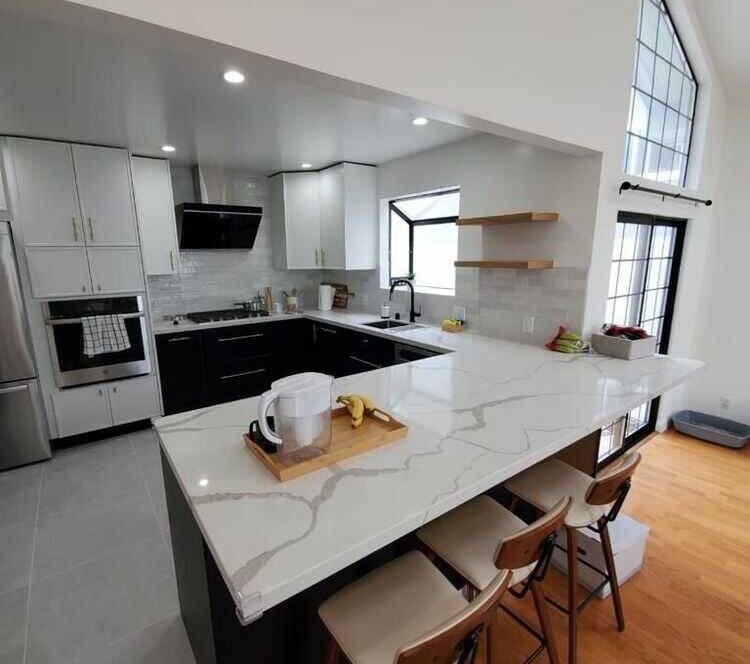
- How long will it last? A quartz countertop made with natural stone scraps and a durable binder might outlast and outperform a rare marble that requires constant sealing and is prone to etching. The sustainable choice is often the more durable, low-maintenance one.
Here’s a practical comparison we often walk clients through when considering key material choices:
| Material Category | The “Conventional Luxury” Choice | The “Sustainable Luxury” Alternative | The Real-World Trade-Off |
|---|---|---|---|
| Flooring | Imported exotic hardwood (e.g., Brazilian Cherry) | Locally-sourced or reclaimed domestic hardwood (e.g., White Oak), FSC-certified | The alternative can have equal beauty and durability, often with a more unique story. May require more sourcing effort. |
| Countertops | Virgin stone (granite, marble) quarried and shipped internationally | Recycled-content surfaces (e.g., engineered quartz with recycled content), premium porcelain slab, or locally-quarried stone | Recycled-content surfaces offer superior stain/resistance and consistency. The “look” of natural stone is harder to replicate perfectly. |
| Insulation | Standard fiberglass batt | Dense-pack cellulose, mineral wool, or spray foam (with low-GWP blowing agents) | Advanced insulations offer superior air sealing and sound dampening. Cost is higher, but energy savings and comfort are significantly greater. |
| Cabinetry | Custom cabinets with standard MDF cores and laminate finishes | Custom cabinets with NAUF (No Added Urea Formaldehyde) cores and low-VOC finishes | Healthier indoor air from day one. Durability and cost are comparable; selection of specific finishes/colors may be slightly narrower. |
Systems Thinking: Where Luxury and Efficiency Become Inseparable
This is the heart of the modern sustainable luxury home. It’s not about slapping some solar panels on a poorly insulated roof. It’s about integration.
- The Envelope First: Before we talk about HVAC, we obsess over the building envelope—air sealing, high-performance windows, and deep insulation. In San Jose’s climate, with our cool nights and warm, dry days, a tight envelope lets us specify smaller, more precise heating and cooling systems. The luxury is in the silent, even comfort and the negligible utility bills.
- Water is the New Energy: After our drought cycles, luxury homeowners aren’t just asking about low-flow toilets; they’re planning whole-house water management. Think recirculating hot water systems that deliver instant hot water without wasting gallons down the drain, paired with sophisticated greywater systems for irrigation. In older neighborhoods like Naglee Park or Rose Garden, where plumbing infrastructure can be dated, this systems approach solves performance issues while conserving a critical resource.
- Electrify Everything (and Make it Smart): The push toward all-electric homes is strong here. Induction cooktops that outperform gas, heat pump water heaters that are 3-4x more efficient, and ductless mini-split systems for additions. The luxury layer is in the smart integration—a system that learns your patterns, pre-heats your bathroom floor, and manages solar battery storage to maximize your independence from the grid.
When Sustainability and Budget Collide: A Real Talk Section
Let’s not sugarcoat it. Many sustainable choices have a higher upfront cost. The premium insulation, the high-efficiency heat pump, the custom reclaimed wood feature wall—they all cost more than their standard counterparts. The calculus has to shift from initial cost to total cost of ownership.
That induction range might cost more than a premium gas range, but you’re not paying for a gas line extension or future gas hookup fees (which are only going up). You’re also getting a cooler, cleaner kitchen. The added insulation and better windows might add 5-10% to your construction budget, but they will shave 30-40% off your monthly energy bills, forever, and make your home dramatically more comfortable.
When might a “green” feature not be appropriate? If you’re flipping a house or know you’ll only be in it for 2-3 years, you likely won’t recoup the investment. Also, in some historic districts, visible additions like solar panels can face regulatory hurdles, though integrated solar tiles are changing that game.
The Human Element: It’s All About the Team
You can have the best sustainable materials spec’d on paper, but if your contractor is used to dumping everything in a single roll-off bin and your designer is selecting products purely on aesthetics, the vision will fall apart. A successful sustainable remodel requires a team that’s aligned on the goals from day one.
This means:
- A contractor who practices construction waste sorting (separating wood, metal, concrete for recycling).
- A designer who understands material sourcing and lifecycle.
- An architect who models energy performance.
- And a homeowner who is patient when a specific reclaimed material takes time to source.
We’ve learned that the projects that run smoothest are where we’re brought in during the design phase. We can flag potential cost vs. value issues, suggest alternative materials that are easier to install or source locally, and plan for system integrations that would be prohibitively expensive to retrofit later.
Making It Happen in San Jose: Local Considerations
Our specific environment shapes these decisions. The California Title 24 energy code is already strict, so any luxury remodel is starting from a high-efficiency baseline. Going beyond code is where you see the real benefits. The sunny climate is a gift for solar, but the dry heat also means focusing on passive cooling strategies—deep overhangs, strategic window placement, and materials with thermal mass.
And a note on permits: the City of San Jose is increasingly encouraging sustainable builds. While the permit process can be detailed, having clear documentation on energy modeling, water efficiency calculations, and waste management plans can sometimes smooth the path. It shows you’re building to a higher standard.
The Bottom Line
Sustainable luxury remodeling isn’t a checklist; it’s a mindset. It’s asking “why” and “how long will it last” as often as you ask “what does it look like.” It’s understanding that the truest form of luxury in 2026 isn’t just opulence, but resilience, health, and quiet responsibility. It’s building a home that feels good to live in, not just because of its beauty, but because of its intelligence. And in a place as forward-thinking as San Jose, that’s simply the new standard for what it means to build well.
People Also Ask
Planning an eco-friendly and sustainable home renovation starts with a comprehensive waste management strategy. Before demolition, sort materials for donation, recycling, or reuse to divert debris from landfills. Choose low-VOC paints, reclaimed wood, and energy-efficient appliances to reduce your environmental footprint. Proper insulation and high-performance windows improve energy conservation. For San Jose remodels, managing construction waste responsibly is critical. You can read more about this in our internal article titled The Guide To Managing Construction Waste And Recycling For San Jose Remodels. Lecut Construction emphasizes that a sustainable renovation also involves working with suppliers who prioritize recycled or locally sourced materials. By focusing on these steps, you create a healthier home while minimizing ecological impact.
For eco-friendly home construction, the best approach combines sustainable materials like reclaimed wood, bamboo, and recycled steel with energy-efficient design. At Lecut Construction, we emphasize that the most eco-friendly material depends on your specific project goals, including durability and local climate. For insulation, which is critical for energy savings, we recommend exploring natural options. You can find detailed guidance on this in our internal article titled Eco-friendly And Non-toxic Insulation For San Jose Homes, which covers non-toxic insulation suitable for San Jose homes. Ultimately, a holistic strategy using locally sourced, renewable materials and minimizing waste yields the greatest environmental benefit.
The most environmentally friendly house to build is one designed with passive solar principles, using sustainable materials like reclaimed wood or recycled steel, and incorporating high-efficiency insulation and windows. A net-zero energy home, which produces as much energy as it consumes through solar panels and geothermal systems, is a top choice. For projects in San Jose, Santa Clara, or Sunnyvale, CA, Lecut Construction emphasizes using low-VOC paints and locally sourced materials to reduce transportation emissions. Water conservation features, such as rainwater harvesting and drought-tolerant landscaping, are also critical. Ultimately, the greenest home minimizes its carbon footprint through durable construction, renewable energy, and responsible waste management during the building process.
To build an eco-friendly house, you need a focus on energy efficiency, sustainable materials, and water conservation. Start with high-performance insulation and airtight construction to reduce heating and cooling loads. Install energy-efficient windows and appliances, and consider renewable energy sources like solar panels. Use low-VOC paints, reclaimed wood, or recycled materials for finishes. Water-saving fixtures and rainwater harvesting systems are also key. For homeowners in San Jose, understanding local codes is essential. For a detailed approach, refer to our internal article titled Zero Net Energy (ZNE) Home Remodeling Guide For San Jose Properties, which covers strategies for Zero Net Energy compliance. Lecut Construction recommends this guide for navigating sustainable upgrades in Santa Clara County.